Composition Patterns
Four progressively governed architectures — from Minimum Viable Control to a Full Governed Agentic System. Start with five primitives and grow as stakes demand.
The nineteen AGF primitives don't all activate at once. They compose into progressively more governed architectures — each stage independently valuable, each stage a foundation for the next.
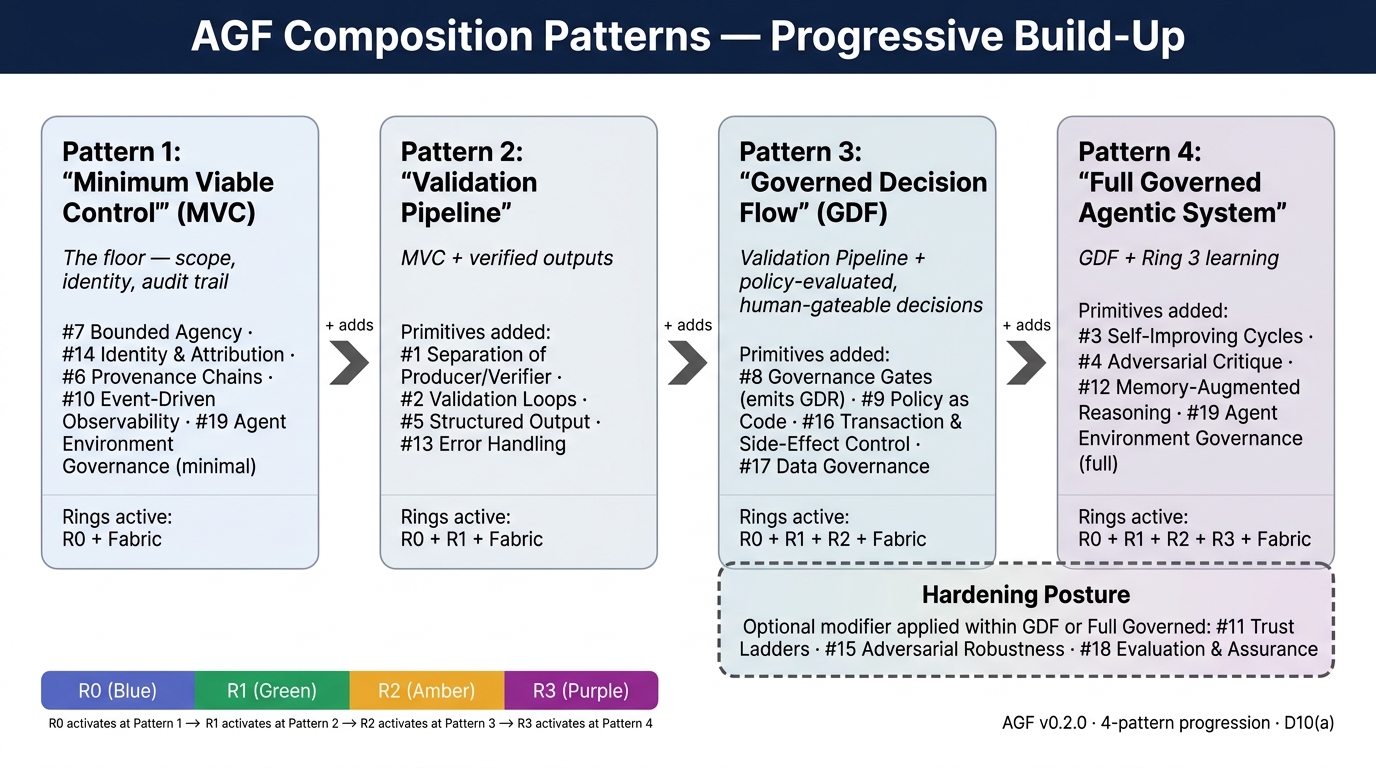
Organizations start at Minimum Viable Control and grow toward Full Governed as stakes, scale, and regulatory requirements demand. This is not a binary choice — it is a maturity continuum.
The Four Patterns
Minimum Viable Control
The floor for any consequential agent system.
Primitives: Bounded Agency (#7) + Identity (#14) + Provenance (#6) + Observability (#10) + Environment Governance (#19, minimal)
What it gives you: agents that can't exceed their scope, actions that are attributable, an audit trail, and scoped operating environments.
This is Ring 0 only — no verification layer yet. But it's more governance than most organizations have today. ("most organizations" reflects practitioner observation across consulting engagements 2024–2026; we have no industry survey to cite.) If you're starting from zero, start here.
Validation Pipeline
Ring 0 + Ring 1
Primitives: Minimum Viable Control + Separation of Producer/Verifier (#1) + Validation Loops (#2) + Structured Output (#5)
What it gives you: verified outputs before release. The fundamental principle — the agent that creates output must not be the sole agent that validates it — becomes structural rather than manual.
The key addition is the Rings Model's core insight: Ring 1 provides an independent verification layer that loops until convergence and can challenge as well as confirm.
Governed Decision Flow
Ring 0 + Ring 1 + Ring 2
Primitives: Validation Pipeline + Governance Gates (#8) + Policy as Code (#9) + Transaction Control (#16)
What it gives you: policy-evaluated, human-gateable decisions with side-effect management.
Ring 2 adds two classes of gates:
- Adaptive gates relax as agents build a track record through Trust Ladders
- Mandatory gates never relax — irreversible actions, regulatory requirements, and legally mandated reviews always fire
This is the pattern for most regulated enterprise deployments.
Full Governed Agentic System
All rings, all primitives, zero trust at every boundary
Every ring active. Every primitive engaged. The environment optimization loop improving the substrate continuously.
What it gives you: the complete governance architecture for high-stakes, regulated, enterprise-grade agentic systems.
This includes:
- Ring 3 (Learning) observing execution patterns and proposing improvements
- Security Intelligence monitoring trust trajectories and behavioral baselines
- Evaluation & Assurance (#18) running continuous regression
- The self-improving loop: Ring 3 proposes, Ring 2 validates, Ring 2 decides
The invariant across all levels: The system can suggest policy changes. It cannot enact them autonomously.
Hardening Posture — a modifier, not a pattern
Between Governed Decision Flow and Full Governed Agentic System sits a real architectural distinction: a system can be production-hardened with defense-in-depth, pre-deployment assurance, and trust calibration before Ring 3 learning is enabled. That hardening posture is:
- Adversarial Robustness (#15) — defense in depth, assume breach
- Evaluation & Assurance (#18) — pre-deployment validation, the gate before the gate
- Trust Ladders (#11) — earned autonomy, not granted by default
This is a posture applied within Governed Decision Flow — or as a precondition for entering Full Governed — not a fifth named pattern. Naming it as a peer of MVC/Validation Pipeline/GDF/Full Governed would be redundant (it's "Full Governed minus Ring 3 learning") and would worsen naming density without adding architectural distinction. Express as posture language in prose: "a production-hardened Governed Decision Flow applying #11/#15/#18."
Most regulated enterprise deployments live in this posture on top of GDF, whether or not they ever enable Ring 3.
Cost of Governance
Every ring adds overhead. AGF is designed for proportional activation:
| Stakes | Ring Activation | Overhead Multiplier |
|---|---|---|
| Low-stakes task | Ring 0 + minimal Ring 1 | Near-zero |
| Medium-stakes task | Ring 0 + Ring 1 + adaptive Ring 2 | 1.5–3× Ring 0 alone |
| High-stakes decision | All four rings, mandatory gates | 3–5× Ring 0 alone |
| Critical-stakes system | All rings + enhanced Security Intelligence | 5×+ Ring 0 alone |
Trust Ladders are the primary cost optimization mechanism. As trust builds through demonstrated performance, verification intensity decreases and adaptive Governance Gates relax. Mandatory Governance Gates always fire regardless of trust level. The system starts expensive and gets cheaper.
The Self-Improving Loop
Once Ring 3 is active, AGF is designed to get better over time:
- Ring 3 observes execution patterns across all rings
- Ring 3 proposes improvements — better prompts, tighter thresholds, calibrated trust levels, optimized environment configurations
- Ring 2 validates — Ring 2 evaluates whether the proposed change stays within policy
- Evaluation & Assurance (#18) tests — regression suites verify the change doesn't degrade known-good behaviors
- The change deploys — with staged rollout and monitoring
This loop applies to both pipeline performance (Ring 3 improves how agents produce outputs) and the agent operating environment (Ring 3 improves context composition, instruction architecture, and tool provisioning through Environment Governance #19).
Key Tensions
AGF names seven tensions between primitives with architectural resolutions. Three are central to composition:
Governance vs. Latency. More governance means more safety but more latency. Resolution: deployment mode selection. Wrapper mode accepts latency for governance clarity; graph-embedded mode minimizes latency at the cost of audit complexity. The Mode Selection Matrix in the Governance Framework is the decision tool.
Self-Improvement vs. Reproducibility. Ring 3 makes the system better, but changes make it harder to reproduce past behavior. Resolution: Ring 3 changes go through versioned configuration management. Every configuration state is traceable and reproducible. The system improves forward; it doesn't drift.
Environment Optimization vs. Governance Integrity. The environment optimization loop makes agents more effective, but the environment is the control surface. Resolution: separate the optimizable (context priorities, tool descriptions, session policy) from the inviolable (Ring 2 policy, authorization boundaries, security constraints). The loop can improve the agent's experience within Ring 2 boundaries; it cannot move the boundaries.
Where to Start
If you are responsible for an agentic system in production today, the practical question is: which pattern are you at?
- No scope constraints, no attribution, no audit trail → Start at Minimum Viable Control
- MVC in place, outputs reviewed manually → Move to Validation Pipeline
- Verification structured, governance ad hoc → Move to Governed Decision Flow
- Regulated or high-stakes with a defensible security story → GDF + hardening posture (#11/#15/#18)
- Continuous learning with governance on the improvement loop → Full Governed Agentic System
Each stage is independently valuable. The goal is not to reach Full Governed as fast as possible — it's to match governance intensity to the stakes of what you're building.
If you are at the first bullet above, the 30-day Minimum Viable Control path is the concrete workplan for getting to the floor. To see what a single request looks like once you have Ring 1 and Ring 2 in place, the End-to-End Reference Walkthrough traces one decision through the full Governed Decision Flow.
For the complete primitive catalog including all 19 patterns, see the AI Engineering Profile. For how composition patterns map to regulatory requirements (EU AI Act, NIST AI RMF), see the GRC Profile.
Trust Ladders
How agentic systems earn autonomy — a governance pattern for calibrated, evidence-based trust that starts expensive and gets cheaper.
First 30 Days — Minimum Viable Control
A concrete four-week workplan for deploying the Minimum Viable Control composition pattern. Week-by-week goals, primitives activated, artifacts produced, and exit criteria to move toward a Validation Pipeline.