AI Engineering Profile
Which primitives to implement first, and how they compose into governed agentic systems.
For AI engineers, ML engineers, prompt engineers, and agent developers building agentic systems that need to be governed, auditable, and improvable.
The key question this profile answers: Which primitives do I implement first, and how do they compose into governed systems?
The Engineering Challenge
Building an agentic system that works in a demo is straightforward. Building one that is trustworthy, auditable, and improvable in production is a different problem entirely.
- Governance must be composable. You can't implement all 19 primitives at once. You need to know which ones to start with and which to defer.
- The architecture must adapt to your system type. A batch pipeline and a conversational agent have different governance needs. The primitives are the same; the composition is different.
- The system must improve without breaking governance. Self-improvement that weakens verification or bypasses gates is worse than no improvement at all.
Implementation Path: Four Composition Patterns
AGF organizes implementation around four canonical Composition Patterns rather than time-bound phases. Each pattern is independently valuable; you don't need the next one to get value from the one you're on. Earlier drafts of this profile used "Phase 1–5" language; that progression is retired in favor of pattern names per Decision D10(a). For the canonical pattern reference, see Composition Patterns; for a week-by-week starter, see First 30 Days.
Pattern 1 — Minimum Viable Control (start here)
| Primitive | Why First | Effort |
|---|---|---|
| #7 Bounded Agency | Without boundaries, everything else is moot | Low |
| #14 Identity & Attribution | Without identity, you can't audit or attribute | Medium |
| #6 Provenance Chains | Without provenance, you can't answer "why did it do that?" | Low |
| #10 Event-Driven Observability | Without events, you're blind | Low |
| #19 Agent Environment Governance (minimal) | Scoped workspace + versioned instructions | Low |
What this gives you: Agents that can't exceed their scope, actions that are attributable, an audit trail, and visibility.
Pattern 2 — Validation Pipeline (Ring 0 + Ring 1)
Adds verified outputs on top of MVC.
| Primitive | Why Now | Effort |
|---|---|---|
| #1 Separation of Producer/Verifier | Verified outputs before release | Medium |
| #2 Validation Loops | Iterative improvement with convergence | Medium |
| #5 Structured Output Persistence | The data contract that makes rings composable | Low |
| #13 Error Handling & Recovery | Graceful failure when things go wrong | Medium |
What this gives you: Verified outputs. Quality assurance is structural, not manual.
Pattern 3 — Governed Decision Flow (Ring 0 + Ring 1 + Ring 2)
Adds policy-evaluated, human-gateable decisions on top of Validation Pipeline.
| Primitive | Why Now | Effort |
|---|---|---|
| #8 Governance Gates | Human oversight on material decisions; emits a GDR at every gate resolution | Medium |
| #9 Policy as Code | Governance rules as versioned, testable artifacts | Medium |
| #16 Transaction & Side-Effect Control | Safe handling of irreversible actions | High |
| #17 Data Governance | PII, consent, classification at every data flow | High |
What this gives you: Policy-evaluated, human-gateable decisions with side-effect management.
Pattern 4 — Full Governed Agentic System (all rings active)
Adds Ring 3 learning on top of GDF (typically with hardening posture applied — see below).
| Primitive | Why Now | Effort |
|---|---|---|
| #3 Self-Improving Cycles | The learning engine | High |
| #4 Adversarial Critique | Dedicated challenger for high-stakes outputs | Medium |
| #12 Memory-Augmented Reasoning | Persistent knowledge across sessions | Medium |
| #19 Agent Environment Governance (full) | The optimization loop for the environment | High |
Hardening posture (modifier, not a fifth pattern)
For production-bound or regulated deployments, apply the #11 / #15 / #18 hardening stack as a posture modifier within Governed Decision Flow (or as a precondition for entering Full Governed):
| Primitive | Role |
|---|---|
| #15 Adversarial Robustness | Defense in depth. Assume breach. |
| #18 Evaluation & Assurance | The deployment gate. Validates before production. |
| #11 Trust Ladders | Calibrated trust. System earns reduced oversight. |
The 19 Primitives at a Glance
| # | Primitive | Ring | One-Line Description |
|---|---|---|---|
| 1 | Separation of Producer & Verifier | 0+1 | The agent that creates must not be the sole agent that validates |
| 2 | Validation Loops | 1 | Iterative verification until quality met or budget exhausted |
| 3 | Self-Improving Cycles | 3 | System learns from execution history — without retraining |
| 4 | Adversarial Critique | 1 | Dedicated challenger: find flaws, never confirm |
| 5 | Structured Output Persistence | Fabric | Schema-conformant artifacts — the data contract |
| 6 | Provenance Chains | Fabric | Full decision history, immutable, tamper-evident |
| 7 | Bounded Agency | 2 | Explicit, enforced boundaries on scope and authority |
| 8 | Governance Gates | 2 | Execution pauses for authorization; emits a GDR |
| 9 | Policy as Code | 2 | Governance rules as versioned, testable objects |
| 10 | Event-Driven Observability | Fabric | Every ring emits structured events |
| 11 | Trust Ladders | 2+3 | Trust earned through performance, not assumed |
| 12 | Memory-Augmented Reasoning | 0+3 | Persistent memory, not just immediate context |
| 13 | Error Handling & Recovery | Fabric | Checkpointing, graceful degradation, compensation |
| 14 | Identity & Attribution | Fabric | Authenticated, inspectable identity on every action |
| 15 | Adversarial Robustness | Security | Assume breach. Defense in depth. Verify explicitly. |
| 16 | Transaction & Side-Effect Control | 0+2 | Pre-commit/commit/post-commit for irreversible actions |
| 17 | Data Governance | 2+Fabric | Classification, consent, PII, lineage, retention |
| 18 | Evaluation & Assurance | Pre-deploy | The gate before the gate — validates before production |
| 19 | Agent Environment Governance | All rings | Governed context, instructions, tools, workspace, memory |
Composition Patterns Visualized
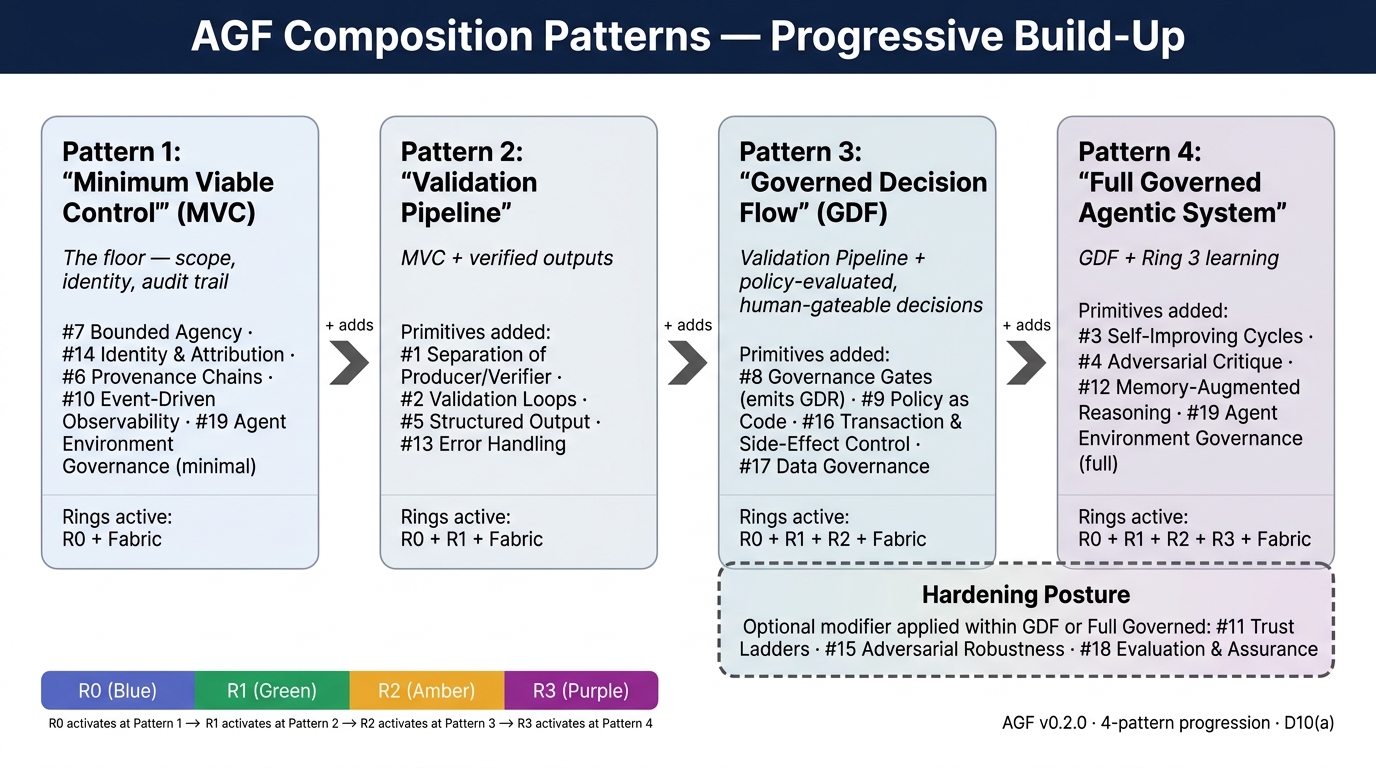
| Pattern | Primitives | What It Gives You |
|---|---|---|
| Minimum Viable Control | #7, #14, #6, #10, #19 (minimal) | Scope, identity, audit trail — the floor |
| Validation Pipeline | MVC + #1, #2, #5, #13 | Verified outputs. Structural quality assurance. |
| Governed Decision Flow | Pipeline + #8, #9, #16, #17 | Policy-evaluated, human-gateable decisions |
| Full Governed Agentic System | GDF + Ring 3 (#3, #4, #12, #19 full); typically with #11/#15/#18 hardening posture | Complete governance that improves over time |
The diagram above shows the four-pattern progression with hardening posture as a modifier band over Patterns 3–4. The retired Phase 1–5 progression diagram (implementation-phases-roadmap.png) has been superseded.
Application Examples
| System Type | Primary Composition | Deployment Mode |
|---|---|---|
| Risk decision platform | Governed Decision Flow + hardening posture | Wrapper |
| Coding agent (Claude Code, Cursor) | Validation Pipeline + selective Ring 2 | Middleware/Interrupt |
| Conversational agent | MVC + graph-embedded verification | Graph-Embedded |
| Document processing pipeline | Validation Pipeline → GDF | Wrapper |
| Personal productivity agent | MVC + selective Ring 3 | Middleware |
Primitive Interaction Tensions
The primitives are not always harmonious. Seven named tensions with architectural invariants:
| Tension | Conflict | Invariant |
|---|---|---|
| Self-Improvement vs. Reproducibility | #3 changes behavior; #6 requires traceability | Always reproducible at a specific version |
| Trust Ladders vs. Governance Gates | #11 reduces oversight; #8 ensures accountability | Can skip a spot-check, never regulatory approval |
| Bounded Agency vs. Self-Improvement | #7 constrains; #3 improves — can it expand itself? | The box can get smarter inside. It cannot grow itself. |
| Validation vs. Latency/Cost | #2 improves quality; each pass costs time and money | Quality bounded by economics, not just capability |
| Memory vs. Signal-to-Noise | #12 accumulates knowledge; stale memories inject noise | Growth without curation is hoarding, not learning |
| Policy as Code vs. Self-Improvement | Can Ring 3 change Ring 2's policy rules? | Can suggest governance changes, cannot enact them |
| Environment vs. Governance Integrity | #19 optimizes the environment — but it IS the control surface | The environment can get better. It cannot get less governed. |
Implementation Checklist (by pattern)
MVC checklist
- Agent scope defined (tool allowlists, data access boundaries, output authority)
- Agent identity established (ID, version, configuration hash)
- Provenance logging active (append-only, structured, includes identity context)
- Structured events emitted at action boundaries
- Workspace scoped and instructions versioned
Validation Pipeline checklist
- Separate verification agent operational
- Validation loops with convergence criteria and iteration budget
- Structured output schema defined and enforced
- Error handling: checkpointing at ring boundaries, graceful degradation
Governed Decision Flow checklist
- Governance gates operational (adaptive + mandatory classes defined)
- Each gate resolution emits a GDR (
pending/resolved/expired/superseded/aborted) - Policy rules versioned and testable
- Transaction control for irreversible actions
- Data classification pipeline active
Hardening posture checklist (apply within GDF or before Full Governed)
- Security posture: defense in depth, supply chain trust policy
- Evaluation suites: pre-deployment, regression, adversarial testing
- Trust Ladders: initial levels set, promotion/demotion criteria defined (promotions/demotions are Domain Outcomes that emit GDRs)
Full Governed Agentic System checklist
- Ring 3 learning pipeline operational
- Memory infrastructure with relevance filtering and curation
- Full environment optimization loop with termination condition
- Adversarial Critique: challenger agent for high-stakes outputs