Platform Profile
Deployment modes, environment architecture, MCP integration, and cost of governance.
For platform engineers, infrastructure architects, and DevOps/MLOps teams responsible for building, deploying, and scaling the infrastructure that autonomous AI agents run on.
The key question this profile answers: How do I build and deploy governed agent infrastructure?
Scope boundary: This profile covers build-time and deployment-time infrastructure. Runtime operations (monitoring, incident response, observability) belong to the Observability Profile. The split mirrors Platform Engineering vs. SRE.
The Platform Challenge
Building infrastructure for governed agentic systems is fundamentally different from building infrastructure for traditional applications. Traditional infrastructure serves deterministic software — the application does what it's told, every time. Agentic infrastructure serves non-deterministic, autonomous systems that select tools, modify their own behavior, and take actions their developers never explicitly programmed.
The platform challenge has three dimensions:
-
Governance must be structural, not bolted on. You can't add governance to an agentic system after the fact — it must be built into the infrastructure from the start. The rings, the verification layers, the gates, the containment mechanisms — these are infrastructure, not application features.
-
The topology must match the system type. A document processing pipeline and a conversational agent have completely different latency requirements, governance patterns, and failure modes. The infrastructure must adapt — the same logical governance deployed in different physical topologies.
-
The agent's operating environment is infrastructure. Context composition, instruction management, tool provisioning, workspace scoping, session state — these are infrastructure concerns that determine agent performance as much as compute and networking.
Ring Deployment Modes
The Rings Model is a logical architecture. How the rings manifest physically depends on the system type, latency budget, and governance requirements. Three modes, each with different tradeoffs:
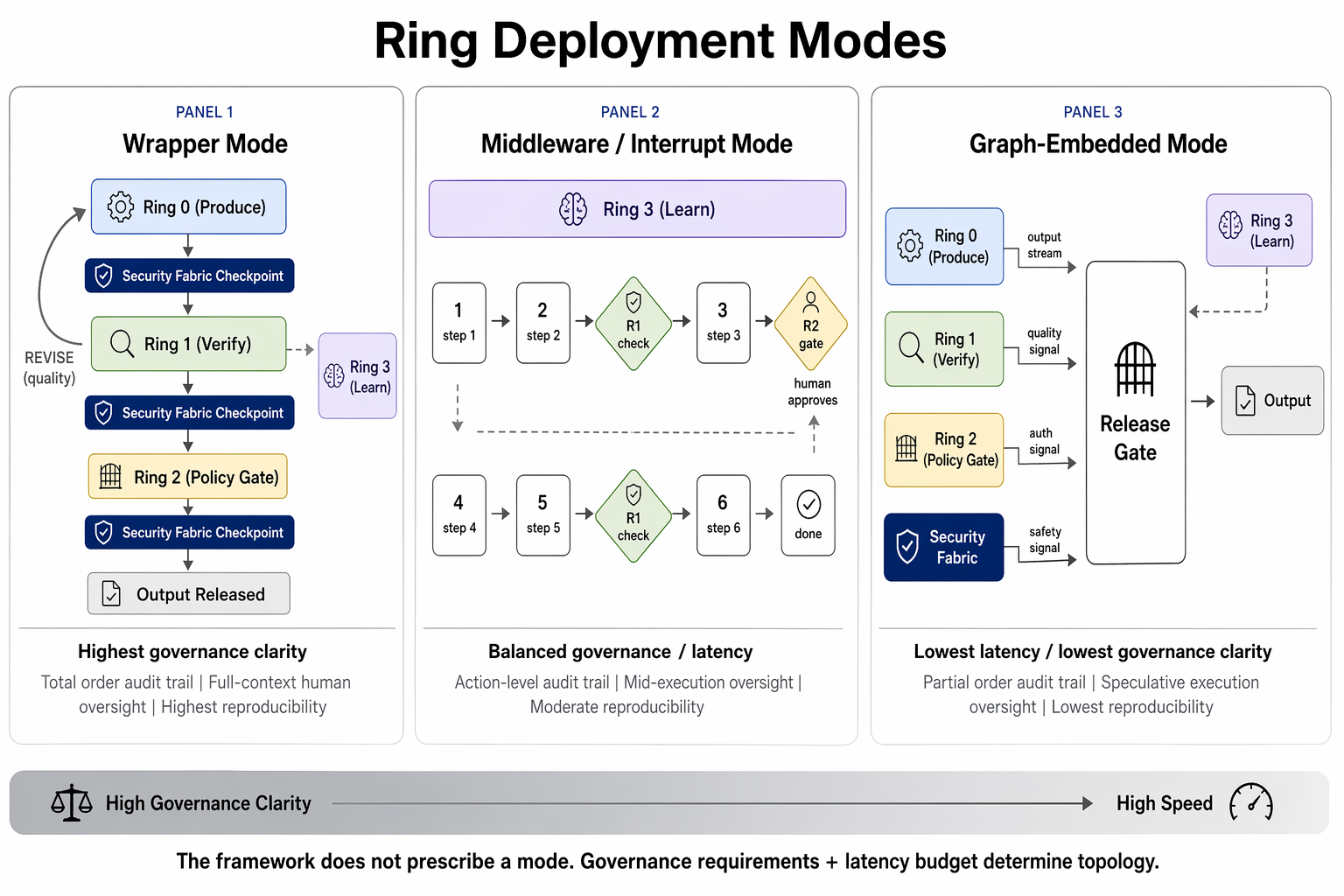
Wrapper Mode
The rings literally wrap execution. Sequential, concentric — Ring 0 produces, Ring 1 verifies, Ring 2 governs, output releases.
Ring 0: Produce output
──── checkpoint ────
Ring 1: Verify (loop until converge)
──── checkpoint ────
Ring 2: Evaluate policy, gate if required
──── checkpoint ────
Output released
Ring 3: Learn (async)| Property | Assessment |
|---|---|
| Best for | Batch pipelines, document processing, assessment workflows, regulatory filings |
| Real-world examples | AI risk assessment pipelines, automated report generation, code review pipelines |
| Latency | Seconds to hours — the full sequential pass adds wall-clock time proportional to verification complexity |
| Audit clarity | Highest — each stage boundary is a clean cut in the provenance chain |
| Human oversight | Easiest — gates pause cleanly, reviewers see complete context |
| Reproducibility | Highest — same inputs + configuration = same trace |
| Tradeoff | Latency. For user-facing agents, the sequential pass may be unacceptable. |
Middleware / Interrupt Mode
Ring logic fires at specific decision points within an execution graph — tool calls, data access, state mutations. The agent executes continuously; the rings intercept at defined boundaries.
step 1 → step 2 → [R1: verify tool] → step 3
                                          │
                    [R2: gate — destructive] ←┘
                              │
                       (human approves)
                              │
                          step 4 → step 5 → [R1: verify output]
                                                    │
                                                step 6 → done

Ring 3: learns from full trace (async)
Security fabric: active at every interrupt boundary| Property | Assessment |
|---|---|
| Best for | Coding agents, ops automation, multi-step task agents, infrastructure management |
| Real-world examples | Claude Code, Cursor, Devin, GitHub Copilot Workspace, CI/CD agents |
| Latency | Sub-second to seconds per action |
| Audit clarity | Good — provenance shows which control points triggered and what was decided |
| Human oversight | Good with constraints — richer context, more domain expertise required |
| Checkpointing | Checkpoint at each interrupt boundary. Agent must be resumable — pausing mid-execution for a gate requires frozen, persisted, resumable state. |
| Tradeoff | Interrupt policy design is hard. Too many = constant pausing. Too few = missed consequential actions. |
MCP as canonical implementation: The Model Context Protocol materializes middleware/interrupt mode directly — the protocol defines the boundary between agent reasoning and tool execution, making each tool call a natural interrupt point.
Graph-Embedded Mode
Verification, governance, and security run concurrently with execution as peer nodes in the orchestration graph.
| Property | Assessment |
|---|---|
| Best for | Conversational agents, voice assistants, real-time systems, agent swarms |
| Real-world examples | ChatGPT-style agents, voice assistants, real-time recommendation engines, trading agents |
| Latency | Milliseconds (user-perceived) |
| Audit clarity | Lowest — concurrent execution produces a partial order, not a total order |
| Human oversight | Hardest — speculative execution means the agent has "moved on" by the time a gate fires |
| Reproducibility | Lowest — concurrency introduces timing-dependent behavior |
| Tradeoff | Latency for governance clarity. Systems subject to regulatory audit should strongly consider wrapper or middleware. |
Speculative execution bounds (Informed proposal):
- Depth limit: 3–4 levels of speculative chaining. Governance overhead grows super-linearly beyond depth 4.
- Entropy constraint: If historical rejection rate for an action class exceeds ~20%, exclude from speculation and process sequentially.
- Side-effect fence: Speculative steps that produce irreversible side effects are held in a commit buffer until the governance release gate clears.
Hybrid Deployment
Systems are not required to use a single mode. The common pattern: middleware mode overall with graph-embedded subsections. The coding agent operates in middleware mode (interrupt-driven), but within a single user-facing response, the generation pipeline uses graph-embedded mode (parallel verification of streamed output).
Mode Selection Matrix
Choose the deployment mode based on system characteristics. When multiple modes could work, prefer the one with stronger governance properties unless latency requirements force otherwise.
| System Characteristic | Wrapper | Middleware | Graph-Embedded |
|---|---|---|---|
| Output type | Discrete artifact (document, report, assessment) | Sequence of actions (tool calls, mutations, operations) | Continuous stream (conversation, real-time feed) |
| Latency tolerance | Seconds to hours | Sub-second to seconds per action | Milliseconds (user-perceived) |
| Governance intensity | High — every output fully reviewed | Selective — consequential actions trigger rings | Minimal blocking — most output auto-passes |
| Human gate frequency | High — frequent pause-and-review acceptable | Moderate — gates at high-stakes actions only | Low — rare, and disruptive when they fire |
| Regulatory/audit | Strong — clear evidence trail required | Moderate — action-level audit sufficient | Light — behavioral monitoring sufficient |
| Side-effect profile | Contained — output is an artifact | Mixed — many actions, some irreversible | Continuous — streaming output, real-time effects |
| Regulatory jurisdiction | EU AI Act high-risk (Art. 9–15) | Most jurisdictions | Permissive or low-risk classification |
| Rollback/compensation | Simple — discard the artifact | Per-action compensation via Transaction Control (#16) | Complex — speculative execution may have committed partial state |
Decision heuristic: If you're unsure, start with middleware mode. It handles the widest range of use cases and has the strongest protocol ecosystem (MCP).
Ecosystem reality (March 2026): No single deployment mode dominates. LangGraph uses graph-embedded governance with state machines; CrewAI uses workflow checkpoint governance; OpenAI Agents SDK uses interceptor/middleware guardrails; Amazon Bedrock AgentCore uses external policy enforcement at the gateway layer. MCP is a connectivity protocol, not a governance mechanism — governance layers are built on top of or alongside MCP.
The Agent Environment Stack
Every agent operates within a 5-layer environment. Each layer has its own composition policy, governance intensity, and lifecycle:
┌──────────────────────────────────────────────────┐
│ L5: Session State                     20-30%     │
│ conversation history, tool results, working      │
│ memory, handoff context                          │
│ Ephemeral, session-scoped                        │
├──────────────────────────────────────────────────┤
│ L4: Retrieved Context                 30-40%     │
│ task-specific knowledge, documents, search       │
│ Dynamic, loaded JIT per task                     │
├──────────────────────────────────────────────────┤
│ L3: Capability Set                    10-15%     │
│ active tools, skills, MCP servers, API access    │
│ Provisioned per role, subject to trust level     │
├─ ─ ─ ─ ─ ─ TRUST BOUNDARY ─ ─ ─ ─ ─ ─ ─ ─ ─ ─┤
│ L2: Instruction Architecture          10-20%     │
│ system prompts, rules, personas, constraints     │
│ Versioned, tested, slow-changing                 │
├──────────────────────────────────────────────────┤
│ L1: Identity & Policy Substrate       5-10%      │
│ agent identity, ring assignment, governance      │
│ policy, trust level, workspace boundaries        │
│ Foundational                                     │
└──────────────────────────────────────────────────┘
         ▲ Composition flow: bottom-up
Trust boundary: Below L3 (L1–L2) is human-authored, version-controlled, and trusted. Above the boundary (L3–L5) is dynamic, runtime-composed, and treated as untrusted input by the Security Fabric.
Percentages are context budget allocation starting points. The Environment Optimization Loop adjusts based on measured effectiveness.
The Composability Interface
AGF defines a standard contract for how agents expose themselves to the ring stack. Every governed agent implements this interface:
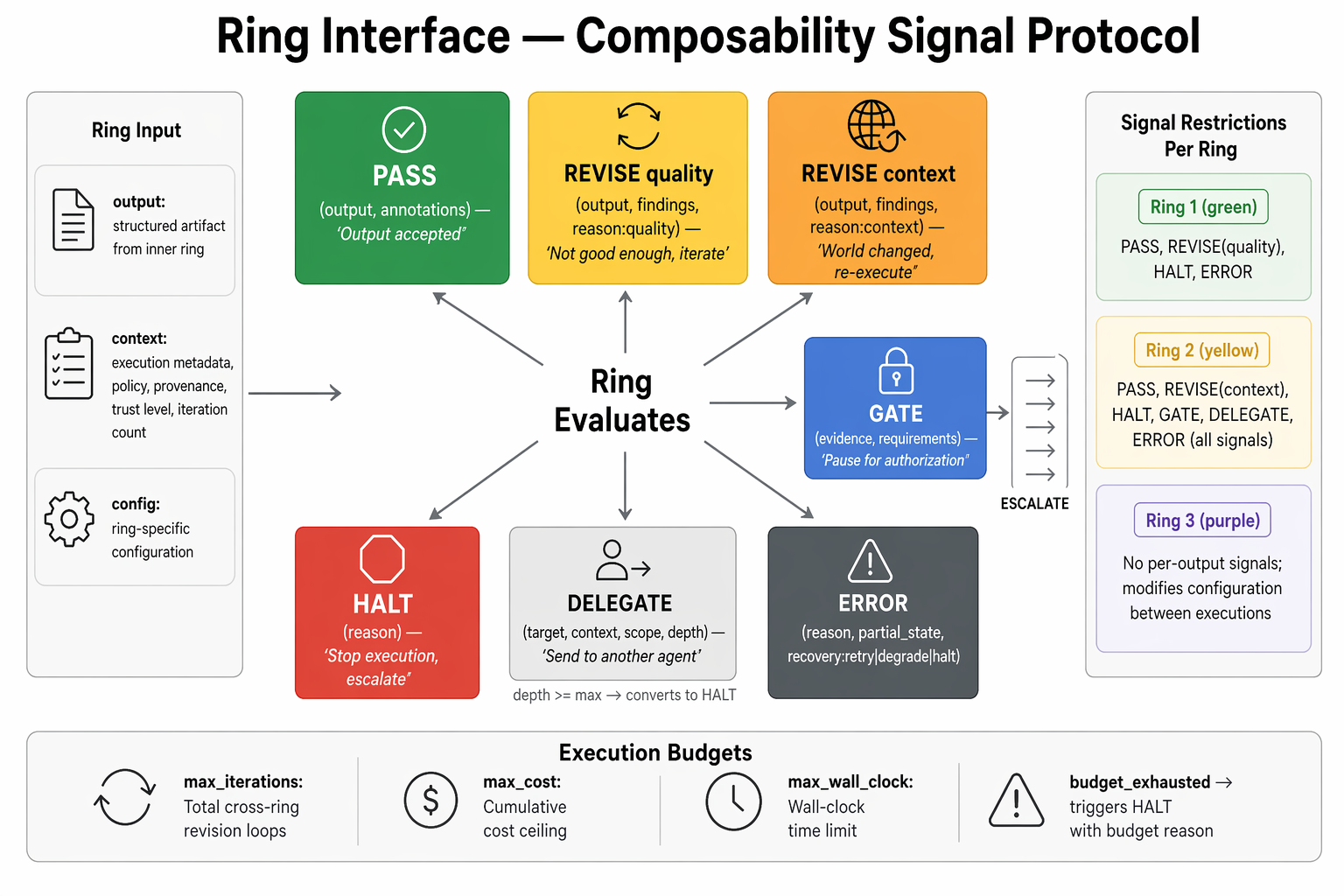
Signal set — what rings return to each other:
| Signal | Meaning | Who Receives |
|---|---|---|
PASS | Output meets criteria | Ring 2 / Release |
REVISE | Output needs change — structured finding attached | Ring 0 (retry) |
HALT | Output cannot be fixed — stop execution | Governance |
GATE | Output meets quality criteria but requires human authorization | Human reviewer |
ERROR | Verification process itself failed | Orchestrator |
Execution budgets: Every ring boundary carries a budget — maximum iterations, time, compute, API calls. Budget exhaustion triggers graceful halt. Without budgets, validation loops can spin indefinitely.
Delegation signals: The DELEGATE signal passes authority to a sub-agent with a bounded scope — the delegating agent's authority cannot be exceeded, only narrowed. Delegation chains are cryptographically bound and auditable.
MCP Integration Patterns
The Model Context Protocol (MCP) is the current dominant protocol for tool integration. AGF's governance layer sits on top of MCP, not inside it.
MCP as the interrupt boundary: Each MCP tool call is a natural interrupt point. The governance layer:
- Intercepts the tool call intent before execution
- Evaluates against policy (is this tool permitted? with these parameters? at this trust level?)
- Either passes, modifies, or blocks
- Records the decision in the event stream
MCP server trust tiers:
| Tier | Source | Trust Level | Governance |
|---|---|---|---|
| Tier 1 — Organizational | Internal, first-party | High | Streamlined approval |
| Tier 2 — Verified | Known vendor, audited schema | Medium | Policy evaluation per call |
| Tier 3 — Community | Public registry, unverified | Low | Sandboxed, mandatory gate on first use |
| Tier 4 — Dynamic | Runtime discovery | Untrusted | Blocked by default, explicit allowlisting required |
Supply chain posture: 53% of community MCP servers use insecure static API keys (Astrix Security, 2025). Default stance: Tier 3 and Tier 4 servers require explicit organizational approval before use.
Cost of Governance
Governance is not free. Every ring boundary adds latency, compute, and complexity. Understanding the cost model helps make informed tradeoffs.
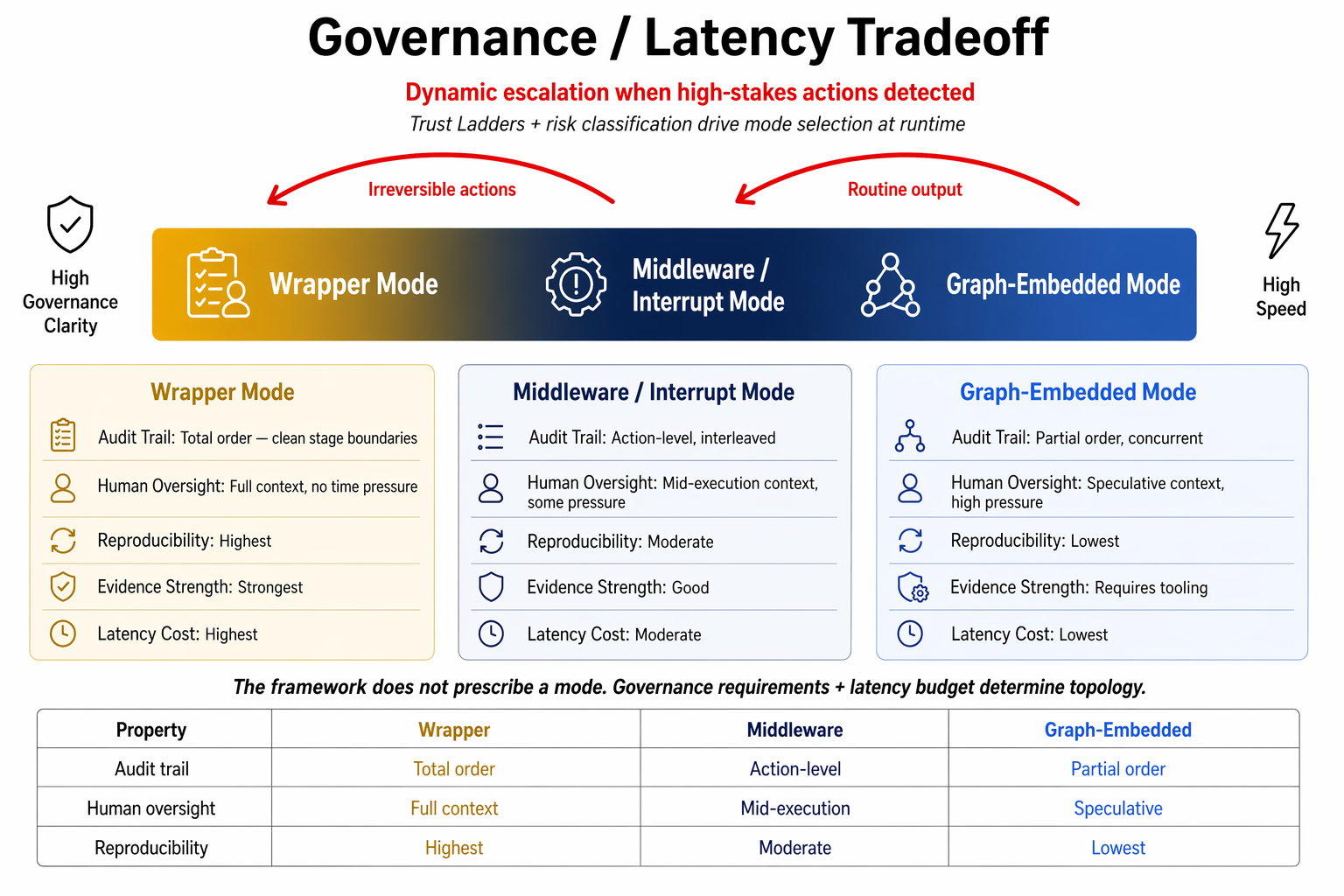
Latency overhead by deployment mode:
| Mode | Ring 1 overhead | Ring 2 overhead | Gate overhead |
|---|---|---|---|
| Wrapper | +20–50% per output | +10–30% per output | Minutes (human review) |
| Middleware | +50ms–500ms per tool call | +50ms–200ms per gate evaluation | Minutes (human review) |
| Graph-Embedded | Near-zero (concurrent) | Near-zero (concurrent) | Disruptive (blocks stream) |
Cost reduction strategies:
- Trust Ladders (#11): Higher-trust agents pass verification faster (fewer iterations, lighter checks).
- Risk-based ring activation: Not every execution triggers all rings. Risk classification determines which rings activate at what intensity.
- Async Ring 3: Learning and analysis run asynchronously — no latency impact on the critical path.
- Adaptive gates: Mandatory only for classified irreversible actions. Routine operations auto-pass.
The governance dividend: Governance costs are offset by reduced failure costs — avoided regulatory penalties, reduced remediation, lower breach costs, and trust that enables higher-stakes automation.
Infrastructure Checklist
Deployment mode selection:
- System type mapped to deployment mode (wrapper / middleware / graph-embedded)
- Latency budget documented and mode selection justified
- Regulatory jurisdiction requirements checked against mode properties
Agent environment:
- 5-layer stack composed (L1–L5) with trust boundary respected
- Versioned system prompts and instructions in source control
- Tool provisioning scoped per role and trust level
- Workspace boundaries enforced (tenant isolation)
MCP integration:
- MCP server inventory documented with trust tier assignments
- Static API keys eliminated from Tier 2–4 servers
- Dynamic discovery blocked by default
Composability interface:
- Signal set implemented (PASS/REVISE/HALT/GATE/ERROR)
- Execution budgets defined per ring boundary
- Delegation chain bounds enforced
Cost of governance:
- Latency overhead measured per ring per deployment mode
- Trust Ladders configured for high-volume, proven agents
- Async Ring 3 confirmed off critical path
Related: Security Profile — security architecture and threat defense. Observability Profile — runtime monitoring and incident response. AI Engineering Profile — which primitives to implement first.