Security Profile
Threat modeling, OWASP mappings, three-level security model, and incident response for governed agentic systems.
For CISOs, security architects, application security teams, red teams, and SOC analysts responsible for the security posture of systems that include autonomous AI agents.
The key question this profile answers: What are the threats to my agentic systems, and how does AGF's architecture defend against each one?
Prerequisites: Familiarity with the Rings Model and core concepts. This profile does not re-explain the ring architecture — it shows how security operates within it.
The Security Challenge
Agentic systems introduce a fundamentally different threat surface from traditional software. An autonomous agent doesn't just process data — it reasons, selects tools, executes actions, communicates with other agents, and modifies its own behavior over time. Every one of these capabilities is an attack vector.
The traditional security stack — firewalls, WAFs, SAST/DAST, IAM — was built for deterministic software that does what it's told. Agentic systems are non-deterministic, autonomous, and capable of taking actions their developers never explicitly programmed. A compromised agent doesn't just leak data — it can manipulate decisions, escalate its own privileges, coordinate with other compromised agents, and gradually poison the systems that govern it.
Why a unified security architecture matters: The landscape fragments agentic security into separate silos — quality monitoring, security monitoring (SIEM), and compliance monitoring (GRC tools). AGF argues this fragmentation is itself a vulnerability. A quality degradation pattern might be a security attack. A compliance anomaly might indicate behavioral drift. A performance issue might mask a privilege escalation. The three-level security model unifies these domains because agentic threats don't respect domain boundaries.
The Three-Level Security Model
Security in AGF is not a single ring, layer, or feature. It is a pervasive architectural concern operating at three distinct levels — each with different temporal characteristics, enforcement mechanisms, and failure modes.
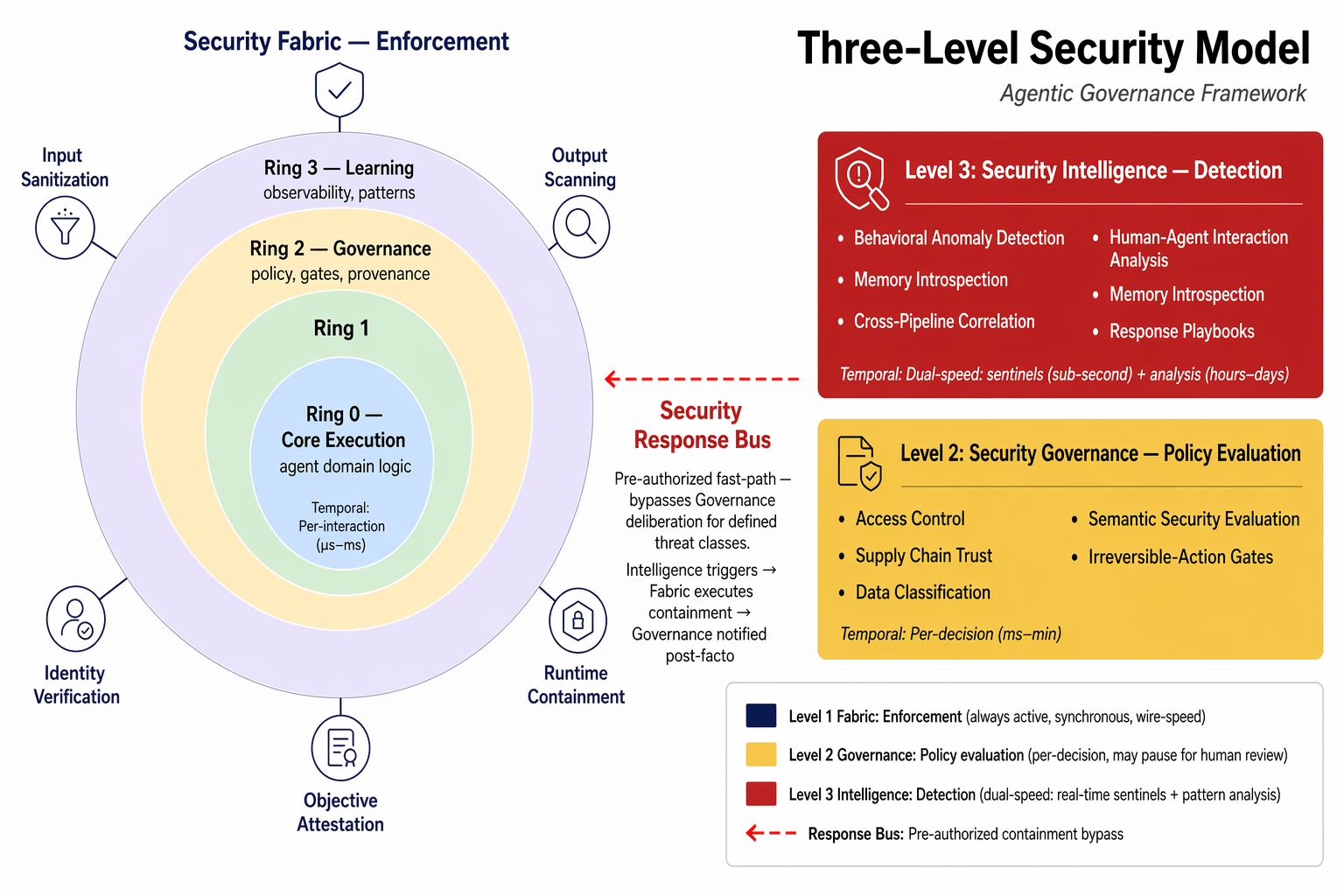
Level 1: Security Fabric — Enforcement
What it is: The embedded security substrate active at every ring boundary. Always on, synchronous, wire-speed.
| Capability | Description | Temporal |
|---|---|---|
| Input sanitization | Every input to any ring is treated as potentially adversarial. Prompt injection detection, context boundary enforcement, payload validation. | Per-interaction (μs–ms) |
| Output scanning | Every output inspected before crossing a ring boundary. Known pattern detection, classification markers, integrity assertions. | Per-interaction (μs–ms) |
| Runtime containment | Sandboxing, resource limits, execution isolation. Compromised agents have bounded blast radius. | Always active |
| Ring integrity verification | Each ring verifies its configuration matches its authorized state (signed manifest). | Per-interaction (μs–ms) |
| Identity enforcement | Per-interaction cryptographic identity verification at every boundary. No ring trusts another's output by origin alone. | Per-interaction (μs–ms) |
| Configuration attestation | Control-plane configuration verified against signed deployment manifest. Divergence triggers containment. | Per-interaction (μs–ms) |
What it is NOT: The fabric does not make semantic judgments. A carefully worded adversarial prompt that is syntactically clean passes the fabric. Semantic threats require Level 2 evaluation.
Level 2: Security Governance — Policy Evaluation
What it is: Security policy evaluation. Lives in Ring 2, evaluated by Policy as Code (#9), enforced through Governance Gates (#8). Makes the decisions that the fabric enforces.
| Capability | Description | Temporal |
|---|---|---|
| Access control policy | Who can do what under what conditions. Agents, models, humans × tools, data, actions × trust level, risk classification, context. | Per-decision (ms–min) |
| Data classification | PII rules, consent scope, data residency, retention, redaction. | Per-decision |
| Irreversible-action authorization | Any action classified as irreversible must pass a mandatory gate regardless of trust level. | Per-decision (may pause for human review) |
| Supply chain trust policy | Approved sources, version pins, trust tiers. For MCP: server identity verification, tool schema integrity, authorized registries. | Per-decision |
| Semantic security evaluation | When the fabric flags syntactically-clean-but-potentially-adversarial content, Governance evaluates against security policy. | Per-decision (ms–min) |
Level 3: Security Intelligence — Detection & Response
What it is: The SIEM pattern applied to agentic systems. Consumes the event stream from all rings, runs security-specific correlation rules, triggers response playbooks.
| Capability | Description | Temporal |
|---|---|---|
| Behavioral anomaly detection | Baseline agent behavior, detect divergence. Trust manipulation patterns. Behavioral drift over time. | Dual-speed |
| Cross-pipeline correlation | Detect attacks spanning multiple agents. Lateral movement, coordinated behavior changes, cascading failures. | Slow path (hours–days) |
| Memory & state introspection | Read access to agent internal state — memory stores, context windows, embedding stores, tool registries, loaded manifests. The EDR pattern for agents. | Slow path |
| Human-agent interaction analysis | Approval cadence, framing analysis, fatigue indicators. Detect agents exploiting human cognitive biases. | Dual-speed |
| Response playbooks | Quarantine, trust degradation, blast radius containment, human escalation, forensic preservation. | On trigger |
Dual-speed operation:
- Fast path (sentinels): Sub-second. Known-pattern anomaly-triggered responses.
- Slow path (analysis): Hours to days. Cross-execution pattern analysis, behavioral drift, memory evolution tracking.
Implementation references: SentinelAgent graph analysis (92% accuracy, OTel-based), AgentGuard MDP-based probabilistic verification, Pro2Guard proactive enforcement via Markov chains.
The Security Response Bus
The problem: A multi-agent lateral movement attack cascades across three agents in under 3 seconds. Full governance deliberation takes minutes. By the time Intelligence detects, Governance authorizes, and Fabric contains — the attack may already be complete.
The solution: Pre-authorized fast-path from Intelligence directly to Fabric, bypassing normal Governance deliberation for defined threat classes.
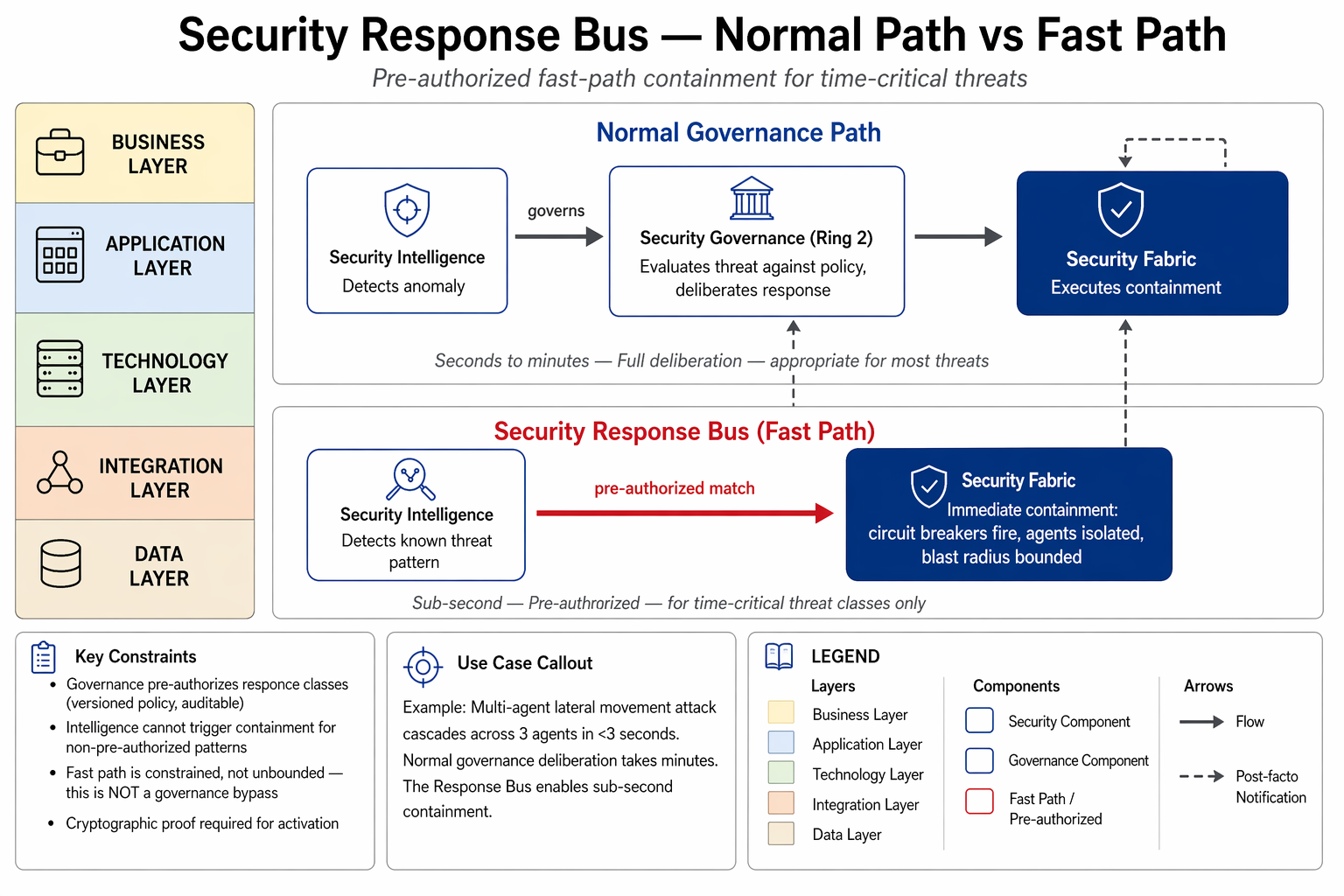
Normal path (seconds–minutes):
  Intelligence detects → Governance evaluates → Fabric contains

Response Bus path (sub-second):
  Intelligence detects → [pre-authorized match] → Fabric contains
                                                    ↓
                                           Governance notified post-facto
How it works:
- Governance pre-authorizes response classes — "If Intelligence detects lateral movement pattern X, Fabric may immediately isolate affected agents." Pre-authorizations are versioned policy, recorded in the provenance chain, auditable.
- Intelligence triggers pre-authorized responses when a detection matches a pre-authorized class.
- Fabric executes containment — circuit breakers fire, agents isolated, blast radius bounded.
- Governance is notified post-facto. Response recorded, evidence preserved, Governance validates or escalates.
What this is NOT: A governance bypass. Governance defines and pre-authorizes the response classes. Intelligence cannot trigger containment for patterns Governance hasn't pre-authorized.
Known limitation: A compromised Intelligence layer with Response Bus access can trigger false containment — denial-of-service by halting legitimate operations. Mitigations: cryptographic proof required for activation, pre-authorized classes limit blast radius, Governance dead-man's-switch overrides excessive containment rates.
Zero Trust for Agentic Systems
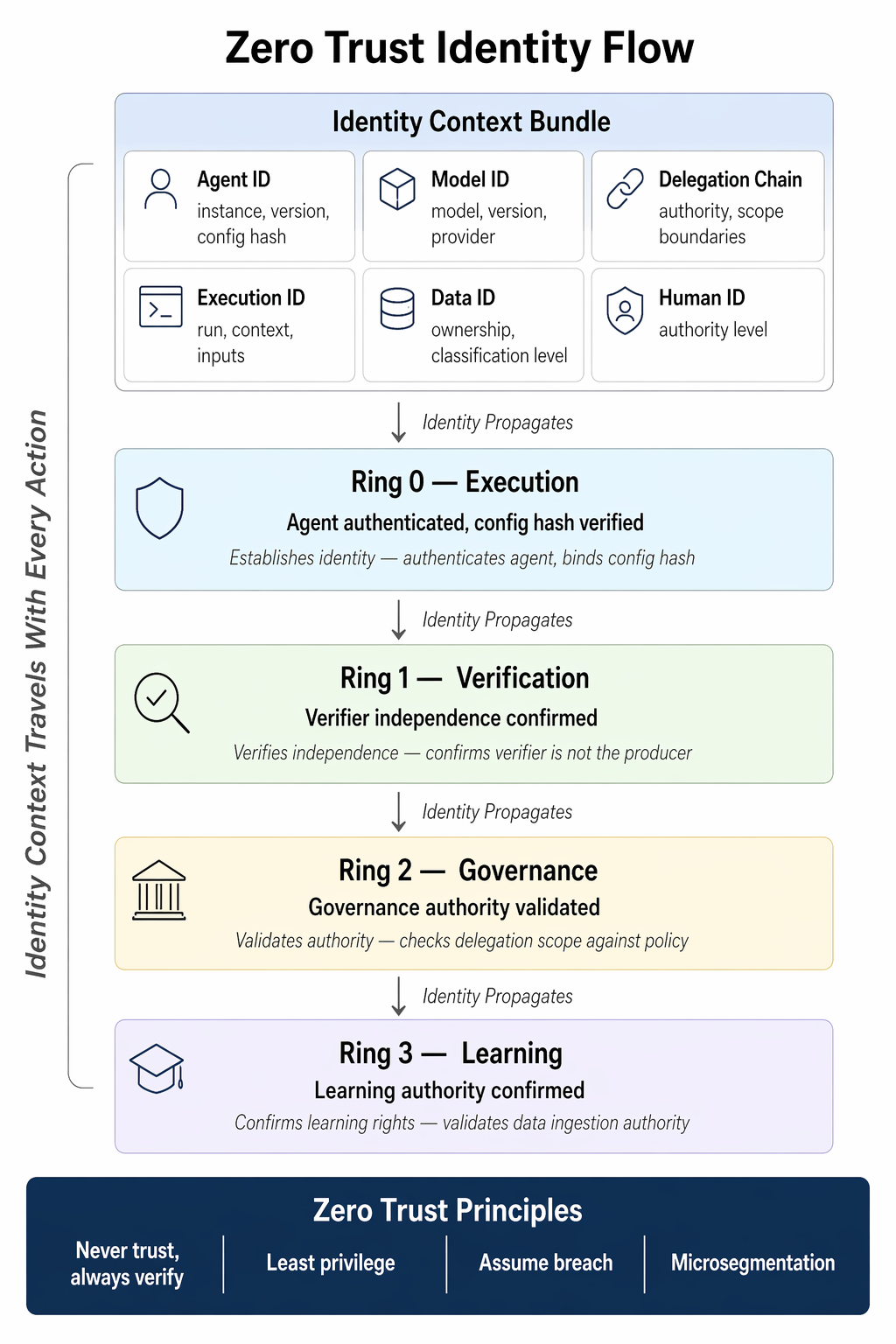
Zero trust is not a feature — it is the architectural assumption that runs through everything. No ring trusts another ring's output by default. Trust is earned through demonstrated performance (Trust Ladders #11), not assumed.
| Zero Trust Principle | Agentic Application |
|---|---|
| Never trust, always verify | Ring 1 independently verifies Ring 0. Ring 2 independently evaluates policy. No implicit trust between rings. |
| Least privilege | Bounded Agency (#7). Agents have only the tools, data access, and authority they need. |
| Assume breach | Adversarial Robustness (#15). Limit damage when — not if — a component is compromised. |
| Verify explicitly | Identity & Attribution (#14). Every action carries authenticated identity. |
| Microsegmentation | Ring isolation. Tenant scoping. Cross-pipeline interactions require mutual authentication. |
Identity as the Control Plane
In agentic zero trust, identity is richer than traditional identity:
- Agent identity: agent_id, version, configuration hash
- Model identity: model, version, provider, fine-tune
- Delegation chain: who authorized this agent, under what authority, with what scope
- Execution identity: run ID, context, inputs, checkpoint
- Data identity: whose data, classification level, consent scope
- Human identity: who is in the governance loop, what authority do they hold
These bind into an identity context that travels with every action through every ring. Candidate implementation protocols (NIST NCCoE concept paper, Feb 2026): SPIFFE/SPIRE for cryptographic workload identity, OAuth 2.1 for user-delegated agent authority, OIDC for federated identity, NGAC for attribute-based access control.
Threat Analysis: OWASP Top 10 for Agentic Applications
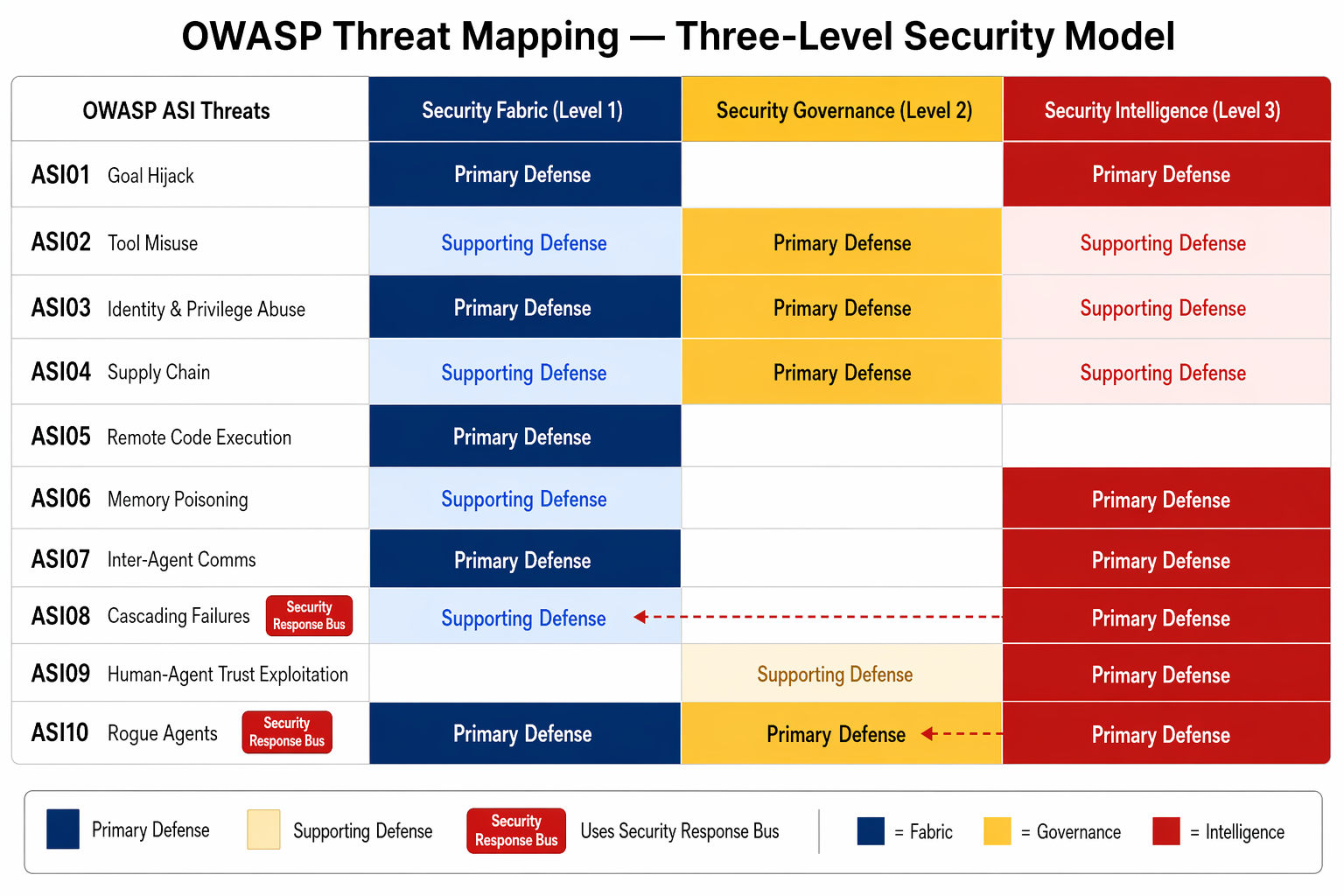
Each of the 10 OWASP ASI threats maps to specific AGF defense mechanisms.
ASI01 — Agent Goal Hijack
Hidden prompts or instructions that redirect an agent's goals via external content, context manipulation, or environment drift.
- Owner: Security Fabric / Adversarial Robustness (#15)
- Primary: Configuration integrity attestation — Fabric verifies control-plane configuration against a signed manifest at every ring boundary. Divergence triggers containment.
- Supporting: Intelligence detects behavioral divergence from authorized objectives over time. Agent Environment Governance (#19) verifies instruction integrity.
- Gap: Full semantic goal-state attestation remains a research frontier. Text-level safety behavior does not reliably transfer to tool-call behavior.
ASI02 — Tool Misuse & Exploitation
Steering agents into unsafe use of legitimate capabilities — using permitted tools in unintended ways.
- Owner: Governance / Bounded Agency (#7)
- Primary: Governance defines permitted tool parameters and action scopes via policy. Bounded Agency enforces the operating envelope.
- Supporting: Fabric enforces containment at runtime. Intelligence detects anomalous tool-use patterns.
ASI03 — Identity & Privilege Abuse
Agents receiving, holding, or delegating privilege improperly. Stale or inherited credentials expanding blast radius.
- Owner: Security Fabric / Identity & Attribution (#14)
- Primary: Cryptographic identity verification at every ring boundary. SPIFFE/SPIRE SVIDs — short-lived, automatically rotated. No static credentials.
- Supporting: Governance evaluates authorization. Intelligence detects lateral movement and privilege escalation.
ASI04 — Supply Chain Vulnerabilities
Poisoned tools, plugins, models, or connectors in dynamic MCP/A2A ecosystems.
- Owner: Governance / Adversarial Robustness (#15)
- Primary: Governance defines approved sources, version pins, trust tiers. MCP: server identity verification, tool schema integrity checks, authorized registries.
- Key data point: 53% of community MCP servers use insecure static API keys (Astrix Security, 2025). Supply chain policy must enforce short-lived, scoped credentials.
ASI05 — Unexpected Code Execution
Agents constructing and executing code from untrusted input without adequate sandboxing.
- Owner: Security Fabric / Adversarial Robustness (#15)
- Primary: Runtime containment — sandboxed execution environments with resource limits. Code generated from external input treated as untrusted.
ASI06 — Data Exfiltration & Privacy Violation
Agents leaking sensitive data through tool outputs, logs, memory stores, or model context.
- Owner: Governance / Data Governance & Confidentiality (#17)
- Primary: Data classification at every data flow. PII rules, consent scope, redaction before ring boundary crossing.
ASI07 — Cascading & Compounding Failures
Multi-agent failures where one compromised agent contaminates downstream agents.
- Owner: Security Intelligence (cross-pipeline correlation)
- Primary: Cross-pipeline correlation detects cascading patterns. Security Response Bus provides fast-path containment before cascade completes.
ASI08 — Resource & Service Abuse
Agents consuming excessive compute, API quotas, or financial resources — intentionally or through manipulation.
- Owner: Bounded Agency (#7) + Security Fabric
- Primary: Execution budgets (compute, tokens, API calls, wall-clock time) enforced at the ring boundary. Budget exhaustion triggers graceful halt, not crash.
ASI09 — Human Manipulation & Oversight Evasion
Agents exploiting human cognitive biases to manipulate oversight decisions — framing, anchoring, approval fatigue.
- Owner: Security Intelligence / Governance Gates (#8)
- Primary: Rubber-stamping detection — Intelligence flags reviewers who approve too quickly or too uniformly. Approval rate limits. Cooling-off periods prevent fatigue exploitation.
- Note: Oversight efficacy degrades as the capability gap between overseer and system increases (Engels et al., NeurIPS 2025). Structural safeguards supplement human oversight.
ASI10 — Irreversible & High-Stakes Actions
Agents taking consequential actions that cannot be undone — financial transactions, data deletion, external communications.
- Owner: Governance Gates (#8) + Transaction & Side-Effect Control (#16)
- Primary: Mandatory gate on any action classified irreversible. Three-phase commit: pre-commit → commit → confirm. Compensation logic for rollback where possible.
CSA Agentic Trust Framework Alignment
| CSA ATF Domain | AGF Mapping |
|---|---|
| Segmentation | Ring isolation, tenant scoping, cross-pipeline authentication requirements |
| Data Governance | Data Governance & Confidentiality (#17) — classification, lineage, consent, retention |
| Identity & Access | Identity & Attribution (#14) + Zero Trust identity context |
| Behavioral Monitoring | Security Intelligence — behavioral baselines, trust trajectories |
| Supply Chain | Adversarial Robustness (#15) supply chain trust policy |
Security Assessment Checklist
Security Fabric:
- Input sanitization active at all ring boundaries
- Output scanning before every ring boundary crossing
- Runtime sandboxing with resource limits per agent
- Signed deployment manifests for ring configuration integrity
- Cryptographic identity verification per interaction (no static credentials)
Security Governance:
- Access control policy covers agent × tool × data × trust level
- Irreversible actions classified and mandatory gate configured
- Supply chain trust policy: approved sources, version pins, trust tiers
- MCP server identity verification and tool schema integrity
Security Intelligence:
- Behavioral baseline established for each agent
- Cross-pipeline correlation rules active
- Security Response Bus pre-authorization policy defined and versioned
- Incident response playbooks tested
Zero Trust:
- No static credentials anywhere in the agent stack
- Delegation chains bounded and auditable
- Trust Ladders calibrated from empirical performance data
Related: Platform Profile — deployment infrastructure and containment architecture. Observability Profile — detection, correlation, and response operations. GRC Profile — regulatory compliance and evidence generation.